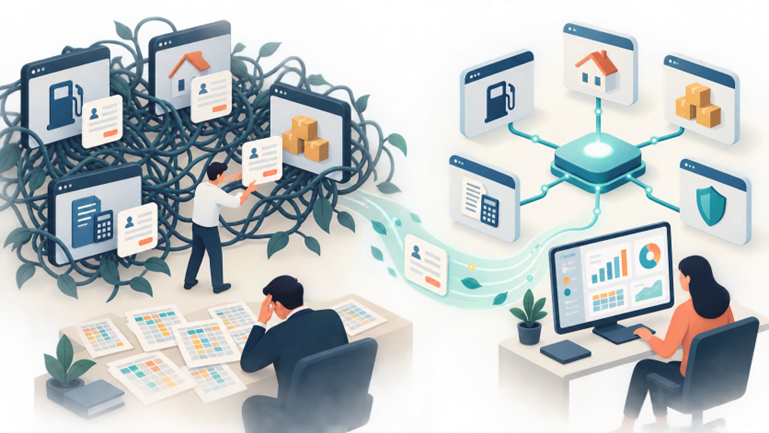
How many times have you had to enter the same information, exactly as it is, into several different systems? From the vehicle fuel card system to the National Housing System, Comprehensive Trade System, Taxpayers System, and so on. If you work as a specialist in an organization, you have probably had to obtain the result of an inquiry from one system and enter it into another. I have personally had to do this several times with the result of a credit assessment: obtaining it from one system and entering it into another. If you are a manager in an organization, you have certainly experienced waiting for several Excel files to be consolidated just to find out, for example, how much has been sold. This is a familiar picture for many organizations: systems have become electronic, but the service still gets stuck between them.
In recent years, we have faced the phenomenon of the "system jungle." The story is that a large number of systems have emerged in organizations to perform various tasks, some of them quite minor. Each system has solved part of its users' problems, but because there is no integration, these systems have themselves become a new problem. Enterprise integration is the path for turning this fragmented collection into coordinated, manageable services. With the issuance of the Agile Enterprise Architecture guideline, this issue has also gained a clearer connection to the formal digital transformation program for the covered executive bodies.
Agile Enterprise Architecture Is Now in Effect: What Are Executive Bodies Required to Do?
In response to the "system jungle" phenomenon, the Administrative and Employment Organization of the Country took an appropriate step. In Dey 1404, it issued the "Guideline for Developing the Implementation Plan for an Agile Enterprise Architecture System with a Digital Transformation Approach." The outbreak of war, however, delayed implementation of this guideline. The guideline requires covered executive bodies to comply with its requirements and emphasizes service-oriented services, process digitization, data-driven governance, and the integration of application software.
According to Article 3 of this guideline, executive bodies must prepare their architecture document and related development and operational plans within six months from the date of issuance. The organization's architecture plan has a two-year horizon, and the implementation documents and plans must be uploaded to the relevant system and approved by the working group before implementation. The architecture is also developed and reviewed in two-year cycles.
Therefore, the deadline for preparing these documents is not the same as the implementation period of all digital transformation projects. Nevertheless, the direction of the guideline is clear: architecture must lead to an execution plan and service improvement. Article 2 also identifies turning enterprise architecture into a continuous process as one of its main objectives.
The text of the directive and its explanations are available in the article “Issuance of the Agile Enterprise Architecture Guideline.” If you are an organization’s IT manager, pay particular attention to the image below.
Why Does Enterprise Architecture Fail to Deliver Practical Results Without Integration?
Enterprise architecture defines the relationships among an organization's objectives, services, processes, data, and technology. From aligning information technology with business needs to coordinating organizational units to execute strategies and interacting with other organizations, all these issues lead to one common question: How should the components of an organization work together to achieve its objectives?
When delivering a service depends on several systems, implementing enterprise architecture requires the actual exchange of information among them. If these connections remain only in architecture documents while specialists continue to transfer information manually from one system to another, a significant part of the value of enterprise architecture will not be realized. System integration is the link between enterprise architecture design and its execution in practice.
Nevertheless, enterprise integration may look simple on paper, but in practice it is complex, time-consuming, and involves numerous exceptions. For example, an application process reaches its result only when the application-registration system can obtain the required information from authorized sources, use the review results in subsequent stages of the process, and inform the applicant of the final status. Executing this process requires reliable communication and coordination among several systems.
Enterprise integration in organizations is usually a multi-layered concept:
Architecture Layer | Integration Topic | Example Application |
Business | Coordination of processes, responsibilities, and service rules | Clear responsibility for each stage from request to final response |
Data | Agreement on meaning, identifiers, and authoritative information sources | A shared definition of "applicant" and use of the same identifier across systems |
Software | Connecting capabilities and exchanging information | Automatically receiving an inquiry result and registering it in the case file |
Infrastructure | Providing secure, stable, and monitorable connectivity | Access control, error handling, and monitoring connection availability |
Technical platforms such as ESBs primarily support the execution of connections and web-service exchange policies. However, decisions about data ownership and schema, the responsibilities of organizational units, and service rules must also be addressed through architecture and organizational management.
Service: The Common Language of Business and Technology
Organizations usually have two teams involved in executing processes: the business team and the IT team. For example, in a licensing process, the business manager talks about the "licensing service," while the IT team talks about APIs, databases, and message exchange. Both teams are working to deliver a service, but they have different languages and perspectives. In enterprise architecture, the concept of a "service" is the common language of business and IT. It defines what value the organization provides and what capabilities it needs to provide that value.
In this context, paying attention to differences in the level of detail, or "granularity," is important. A business service may be delivered by combining several software APIs. For example, a licensing service may use APIs for identity verification, application-status checking, amount calculation, and result registration. Each of these APIs can also be used to deliver other services. This reuse is one of the foundations of service-oriented development.
To manage this relationship in enterprise integration, it must be clear which APIs each business service depends on. The provider, consumer, input, output, access conditions, and expected quality level of each service must also be defined. In this way, API reuse changes from an ad hoc decision into a systematic and manageable approach to developing enterprise services. This approach also makes collaboration among organizational units and service exchange with other executive bodies easier.
Why Do We Need a Platform for Enterprise Integration?
Starting system integration is usually simple. Connecting two systems is often done with the help of an organization's programmers, but as the number of systems and connections among them increases, the complexity grows. Every connection requires development, testing, documentation, access control, monitoring, and maintenance. A change in one system may also affect several connections and services that depend on it.
An integration platform provides a shared environment for creating and managing these connections. Activities such as connecting software services, transforming and mapping data, executing information-exchange flows, managing access, and monitoring services are carried out on this platform. By reducing repetitive work and tool fragmentation, this approach makes enterprise integration simpler and more manageable.
In this approach, new systems communicate with other systems through the platform. Once a system has been connected to the platform, existing services and configurations can be reused to develop subsequent connections. As a result, the need to reimplement connections is reduced and service development becomes faster. In addition, recording service specifications, responsible parties, and dependencies makes it easier to assess the impact of changes and manage relationships among systems.
What Is the Difference Between an ESB and an Integration Platform?
An ESB, or "Enterprise Service Bus," is used to connect systems, route messages, transform protocols, and map data. These capabilities remain essential for many organizations, but an integration platform has a broader scope and, in addition to message exchange, also covers the creation, publication, consumption, management, and analysis of services.
From the perspective of the audience, there is another difference between the two: ESBs are primarily aimed at technical teams, while integration platforms are more focused on business and management teams. The table below shows the difference between an ESB focused narrowly on message exchange and a platform-oriented approach. Of course, the capabilities of different products may overlap.
Topic | ESB Focus on Message Exchange | Integration Platform Approach |
Goal | Establishing communication among systems | Managing connections and service lifecycles |
Development | Designing routes, transforming and processing messages | Development tools, reusable patterns, and release management |
Service Consumption | Providing a calling route | Documentation, service discovery, and API consumption policies |
Management | Technical | Unified view of service consumption, performance, errors, and responsibility |
Service Development | Adding the connections required by a project | Combining existing capabilities to build new services |
Audience | Technical team | Management and business teams |
How Does an Integration Platform Reduce Organizational Costs?
Integration costs can be divided into several areas. The first is development and coding costs, which usually receive the most attention from technical managers and have, of course, been reduced significantly with the help of artificial intelligence. However, the larger hidden portion of these costs relates to monitoring, troubleshooting, and managing services over the long term. This is where a platform approach demonstrates its core value. A platform approach can reduce these costs through several mechanisms:
1. 1. Service reuse: Each service is connected to the platform only once. After that, different systems can use it through the platform. This significantly reduces code-maintenance costs, integration testing, and code deployment, while preventing the accumulation of one-off code and scripts across the organization.
2. 2. Reducing repetitive development in system integration: Connecting to enterprise services usually requires helper functions such as generating unique identifiers, caching results, and normalizing values. Integration platforms typically provide these capabilities out of the box, so technical teams do not have to implement them again for every connection. As a result, code volume and development time decrease, and the IT team can focus more on service management and relationships among systems.
3. 3. Controlling the impact of changes in organizational systems: In the world of information technology, rapid and continuous change has become a permanent part of organizational activities. Integration platforms provide capabilities such as service version management, enabling changes to be introduced gradually and in a controlled manner and reducing their impact on related systems. As a result, business teams face less disruption to their processes and have fewer concerns about the consequences of large-scale and sudden changes.
4. 4. Reducing troubleshooting and incident-resolution time: When system integration is not managed on a shared platform, identifying the root cause of an error and determining the team responsible for resolving it becomes difficult. In such situations, responsibility for the problem may move between teams, and significant time can be spent finding the source of the incident. An integration platform provides a unified view of service and connection status, helping the platform operator identify the cause of an incident more quickly and follow up with the responsible team until it is resolved. This transparency makes it easier to measure availability, track Service Level Agreement (SLA) commitments, and manage other service-quality indicators.
5. 5. Leveraging legacy and existing systems: One of the important benefits of integration platforms is enabling connections to and use of the capabilities of legacy systems. Many organizations, especially under current economic conditions, are reluctant to replace systems that are still working. At the same time, they want to benefit from newer approaches such as service orientation and AI-agent-based software. In such circumstances, connecting legacy systems to an integration platform and exposing their capabilities as services can provide a lower-cost path toward these approaches. A suitable integration platform helps an organization preserve its existing systems while making them available for use in new services and intelligent solutions.
Integration: The Infrastructure for Government Intelligence
These days, everyone is talking about intelligent government and AI-based services. At first glance, we might use tools such as ChatGPT as the benchmark for comparison, but we should understand that delivering intelligent organizational services first requires integrated infrastructure.
An integration platform can provide this controlled access to data and operations. From this perspective, integration is one of the foundations of intelligent government. Data quality, process improvement, access policies, and decision-making responsibilities must also be defined at the same time so that connecting systems leads to real service improvement.
How Does Integropia Help Implement This Path?
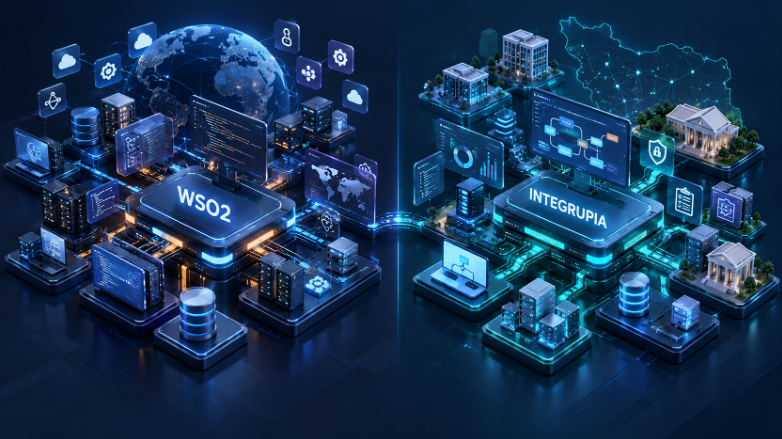
Integropia, MaavarTech's system integration and API management platform, provides ESB capabilities alongside capabilities for managing and developing enterprise services. Connecting to REST and SOAP services and legacy systems, data transformation and mapping, service lifecycle management, and enforcement of API consumption policies are among the product's tested capabilities. Integropia
Integropia's Low-Code integration capability helps reduce repetitive coding, while its monitoring features simplify service-performance analysis, error detection, and API consumption management. Ready-made connectivity to GSB and PGSB is also important for integration with government systems. Of course, the use of target services remains subject to their permissions and access conditions.
Within an enterprise architecture program, Integropia can provide the environment for implementing priority connections and gradually developing services. The goal is to ensure that enterprise architecture is not limited to documents that remain in an archive. Enterprise services should be operationally deployed on a platform, with their status, performance, and relationships visible and monitorable.
Where Should We Start? One Specific Service, One Measurable Result
To begin, select a service in your organization that is both operationally important and dependent on several systems. Break its implementation path into four steps:
1. 1. Understand the current state: Identify the systems, data, responsible parties, and manual information transfers.
2. 2. Design the service and APIs: Define the authoritative data source, service contract, access rights, and behavior in the event of an error.
3. 3. Implement integration gradually: Implement the necessary connections and monitor service quality.
4. 4. Measure and expand: Measure reductions in service time and manual work, and carry reusable services forward into subsequent projects.
This path connects Agile Enterprise Architecture to a tangible outcome: a service that is delivered more smoothly and an infrastructure that makes the next service easier to develop.
Frequently Asked Questions
Question: Is Having an ESB Enough for Enterprise Integration?
Answer: It depends on the organization's needs and the capabilities of the existing solution. If, in addition to message exchange, you need API management, documentation, service reuse, and service lifecycle management, you should assess whether the current ESB covers these capabilities. As a first step toward intelligent enterprise services, we recommend using a modern integration platform that provides these capabilities in a cohesive environment.
Question: Does the Enterprise Architecture Guideline Require Organizations to Purchase an ESB?
The referenced nine-article guideline requires executive bodies to prepare documents, plan, and establish an enterprise architecture system. It does not imply an obligation to purchase a specific product; the selected tool should be appropriate to the approved plan and the organization's needs.
Question: Does Integration Solve the System Jungle Problem?
Integration, together with defining service ownership, data standards, and change management, helps organize system relationships. Decisions about consolidating or eliminating duplicate systems are also part of architecture work and application-portfolio management.
Next Step: Turning the Architecture Map into an Integrated Service
The value of enterprise architecture becomes visible when data reaches the service at the right time, repetitive work is reduced, and developing new capabilities becomes easier. Integropia can provide the technical foundation for connecting, managing, and developing the organization's services.
If your organization is facing a system jungle, the cost of point-to-point connections, or difficulties in implementing its architecture program, select one priority service for assessment. To learn more about the capabilities and discuss your organization’s scenario, visit the Integropia: Enterprise Integration and API Management Platform.
Field | Suggested Value |
SEO Title | Enterprise Integration: From the System Jungle to Beyond ESB |
Slug | enterprise-integration-agile-architecture-esb |
Meta Description | Read about the role of integration in Agile Enterprise Architecture, the difference between an ESB and an integration platform, and how Integropia can reduce the cost of the system jungle. |
Primary Keyword | enterprise integration |
Related Keywords | enterprise integration, Agile Enterprise Architecture, ESB, system jungle, integration platform, API management, intelligent government |
Suggested Category | Enterprise Architecture and Integration |
CTA Destination |