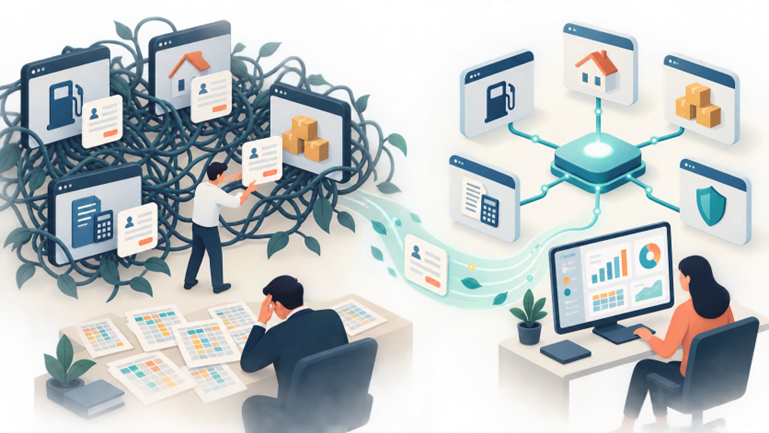
The plan to establish 15 digital government ecosystems could provide an opportunity to organize public services that are currently fragmented across different government agencies. However, the success of this initiative depends on two fundamental questions: Can government agencies reach an agreement on the meaning of shared data and responsibility for managing it? And can the government and private sector build a sustainable relationship based on investment, authority, and accountability?
The answers to these questions will largely determine the future of the “one-stop window” concept and the broader digital ecosystem initiative.
Dr. Mohammad Mohsen Sadr, Deputy Minister of Communications and Head of the Information Technology Organization of Iran, has described digital government as being built around 15 ecosystems covering areas such as healthcare, cross-border trade, logistics, and taxation. In his view, clear division of responsibilities, data integration and harmonization, and joint oversight should replace fragmented services. He considers the proliferation of systems and responsible entities to be one of the causes of complex processes and repeated data entry, and has emphasized the need for a “truly unified window.”
Under the proposed implementation model, a project company, or Special Purpose Vehicle (SPV), would be established for each ecosystem, with management entrusted to the private sector. A return-on-investment model is also envisaged for these companies. Knowledge-based companies could participate in implementing ecosystem projects by forming consortia and leveraging national capacities.
According to Sadr, these projects require capital, infrastructure, and specialized human resources. Although the Ramadan War delayed the ecosystem studies, the Information Technology Organization’s presence at the ELECOMP exhibition and the organization of several specialized sessions on digital ecosystems have once again drawn attention to the implementation of these projects.
However, turning this vision into reality depends on more than connecting systems and creating new one-stop windows. A deeper issue lies underneath: semantic interoperability of data.
When Connecting Systems Does Not Mean Sharing the Same Meaning
Suppose that, within the trade ecosystem, several government agencies exchange information about a business. One agency may define a company as “active” based on the validity of its operating license, while another may use its tax status as the basis for the same concept.
In such a situation, even if information is exchanged flawlessly from a technical perspective, the data will not necessarily have the same meaning.
To prevent this problem, it must be clear what each attribute means, what identifier represents the business, which source is considered authoritative, and how long each piece of information remains valid.
This is what can be described as semantic interoperability: different parties involved in an information exchange should receive and use data based on a shared and agreed meaning.
Therefore, interoperability in digital government is not merely a matter of connecting APIs and exchanging messages between systems. Before that, there must be agreement on the meaning, ownership, authority, and rules governing changes to data.

Why Does Every Ecosystem Need Master Data Management?
Each ecosystem needs the capability of Master Data Management (MDM) to manage this layer—an operational capability that can be provided through an MDM product.
Information about individuals, businesses, products, locations, and service centers should be managed through clearly defined identifiers and rules. Alongside this data, reference codes and classifications also need to be harmonized across different government agencies.
MDM can support the establishment of authoritative sources, data quality control, and the distribution of master data. The importance of this layer can also be seen in the European interoperability framework, where metadata, master data, and reference data management are among the important elements of interoperability architecture.
However, purchasing software does not, by itself, create semantic agreement.
It must be clear:
Which entity is responsible for defining each concept?
Who approves changes to that concept?
If two sources provide conflicting information, which one is authoritative?
Who is responsible for correcting an inaccurate record?
How are data changes recorded and communicated to downstream consumers?
These responsibilities can be distributed among different authoritative sources; there is not necessarily a need to copy all data into a new national database.
The Risk of Creating 15 New Data Islands
One potential contradiction in the ecosystem model is that a project designed to eliminate fragmentation could itself create new islands.
If each of the 15 ecosystems develops its own concepts, identifiers, codes, and data rules, the result could eventually be 15 relatively integrated environments that nevertheless face the same interoperability problems when interacting with one another.
Therefore, ecosystems need not only domain-specific standards but also agreement on concepts shared across domains.
This is where an MDM product becomes an operational tool: a mechanism for implementing data governance agreements and continuously maintaining the data resulting from those agreements.
MDM: From Conceptual Agreement to Operational Execution
At this stage, Mavara’s Master Data Management platform can help project companies and participating government agencies.
The platform provides capabilities for defining domains, entities, and relationships; standardizing codes; and controlling data quality at both attribute and entity levels. These capabilities can provide a foundation for managing shared data.
Assigning ownership to domains and entities and publishing master data to consuming systems can also help operationalize the responsibilities defined through data governance.
The value of such a platform within an ecosystem is not simply the existence of another software product. Its value lies in reducing inconsistencies and providing reliable information for service delivery. Its effectiveness should therefore be measured through clear indicators within each project.

The Second Challenge: Investment and Actual Risk Allocation
Even if the data challenge is addressed, another important question remains: How will the economic model of these ecosystems actually work?
Establishing an SPV alone does not clarify what structure will receive the investment, what obligations the government will assume, or where the project company’s revenue will come from.
The government may act as a regulator, a service purchaser, or a public partner, while the project company itself may be the investment recipient. The central question, therefore, is whether the government is prepared to give investors authority commensurate with the risks they assume and maintain its commitments throughout the operational period.
Simply stating that a return-on-investment model has been defined is not sufficient to assess whether the model is implementable.
If an investor is expected to finance infrastructure and human resources while connectivity between government agencies, authorized access to data, or service tariffs remain outside the investor’s control, significant risks are being transferred without giving the investor adequate tools to manage them.
Several questions must therefore be answered from the outset:
Who is responsible when a government agency delays the delivery of a service?
If a policy change reduces projected revenue, what mechanism will address the impact?
Who is the paying party?
What is the basis for calculating revenue?
Under what conditions, and by whom, can tariffs be changed?
What commitments does the government provide regarding cooperation among different agencies?
These details are part of the project’s economic model and cannot simply be postponed to a later stage.
The Private Sector Must Also Be Accountable
This relationship is not one-sided.
A public-private partnership model only makes sense when the private sector is also accountable for service quality and continuity, cost transparency, and measurable performance.
If an investor expects all commercial risks to be borne by the government while simultaneously seeking exclusivity or guaranteed returns, the logic of the partnership becomes difficult to sustain.
The contract should allocate responsibilities according to each party’s ability to control the relevant risks. It should also clearly define the rules governing service continuity, dispute resolution, and exit from the project.
At the same time, outsourcing operations should not result in exclusive ownership of public data or permanent dependence of government agencies on a single provider.
Data Governance and Investment Are Interdependent
At first glance, data governance and the investment model may appear to be separate issues. In a digital ecosystem, however, they are directly connected.
When it is unclear which authority is responsible for correcting a record, which identifier is valid, or how a change in data should be propagated across agencies, the cost of resolving inconsistencies and providing support increases, while service quality declines.
The same uncertainty can make it more difficult to estimate the costs and revenues of the project company.
For this reason, defining authoritative data sources and establishing Master Data Management should not be postponed until after the project has been designed. These issues should be addressed from the very beginning of the ecosystem’s operational and economic design, alongside the definition of agency responsibilities and investor commitments.
How Should the Success of Digital Ecosystems Be Measured?
Measuring the number of registered companies, launched systems, or connected services is not enough.
The more meaningful questions are:
How many instances of repeated data entry have been eliminated?
How much has the time required to receive a service been reduced?
How many data inconsistencies have been eliminated or reduced?
How clearly are responsibilities for errors defined?
And do citizens and businesses actually receive simpler and faster services?
The real test for these ecosystems will come when the government remains committed to its obligations toward investors, the private sector is accountable for service quality and continuity, and government agencies are able to cooperate on the basis of reliable data and shared meanings.
Ultimately, digital government is not simply a collection of interconnected systems. A digital ecosystem emerges when data, responsibility, and capital are connected through a clear governance model.
If these three layers are addressed simultaneously, the one-stop window can move beyond the superficial integration of systems and become a truly unified service experience. Otherwise, there is a risk that only the form of fragmentation will change—not the underlying problem.