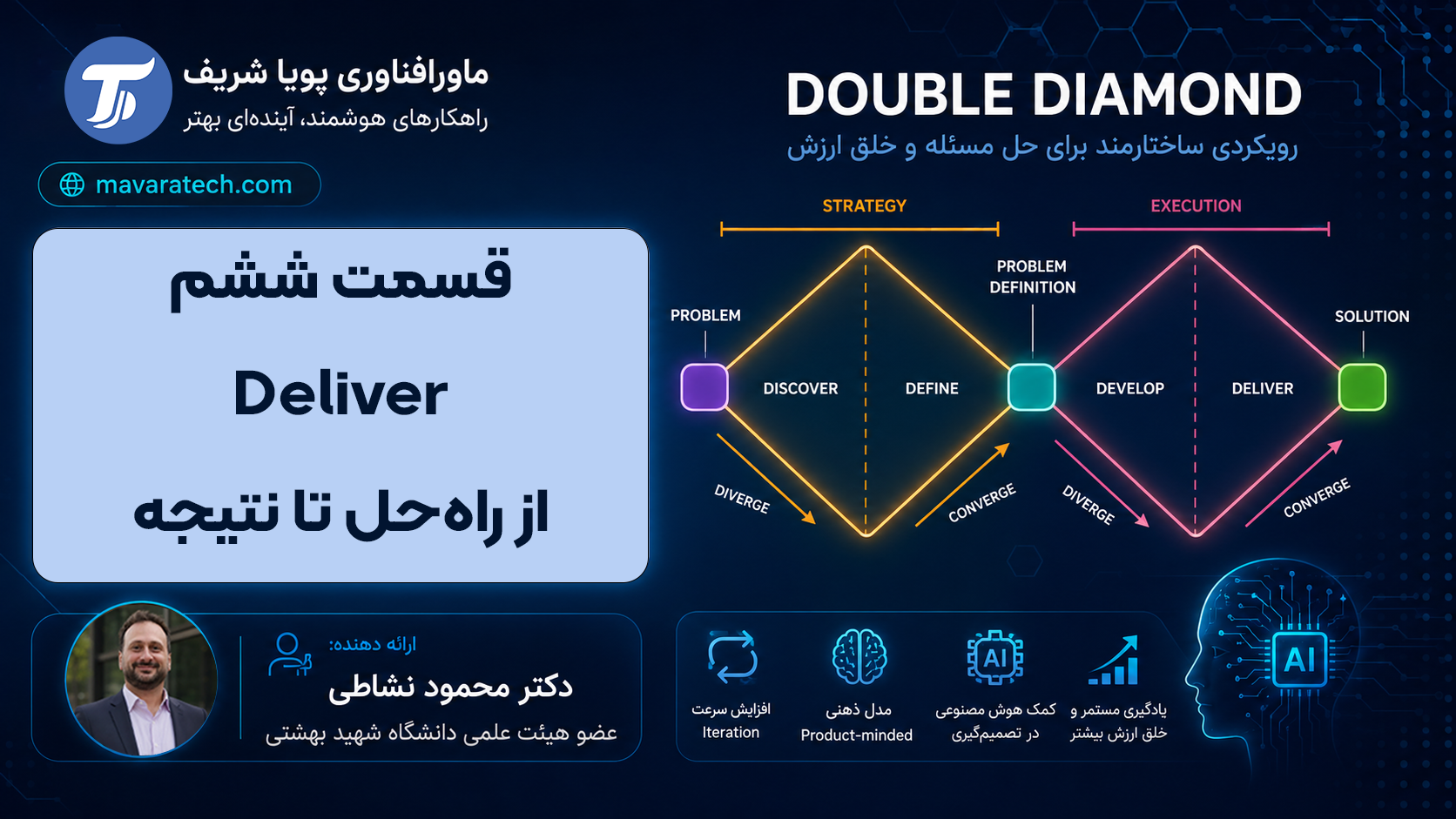
In the fourth stage of the Double Diamond, Deliver, one solution is selected from among the options that were explored and compared during the Develop stage, and the team focuses on implementing it.
However, Deliver is not simply about building, releasing, and deploying a product. One of the key aspects of this stage is that, after the solution is delivered, we should be able to measure its success in the real world and learn from the results.
From Selecting a Solution to Focusing on Execution
During the Develop stage, we explored different options and selected the most suitable solution based on criteria such as Risk, Outcome, and Effort.
In Deliver, the goal is no longer to continuously switch between alternatives. Once a decision has been made, the team should focus on the selected solution, move forward with confidence, and bring it into execution.
Deliver Is Not the End of the Process
In a traditional view, it may seem that once a product has been developed, released, and deployed in the customer's environment, the software engineering process is complete.
In this approach, however, product deployment is not the end of the process.
Two important activities come after implementation:
Measurement: Was the solution we selected and implemented actually successful?
Learning: Did the solution create the expected outcome in the real world?
Define Success KPIs in Advance
An important principle is that success criteria should be defined before the final solution is selected.
For example, KPIs such as Completion Rate, Process Completion Time, and Retry Rate can be used.
Suppose the goal of a feature is to simplify the money transfer process by allowing users to reuse information from their previous transfers. In that case, we should evaluate whether the change actually increased the completion rate, reduced the time required to complete the process, or decreased the number of retries.
These metrics allow us to measure success based on data rather than simply assuming that a feature is successful because it has been built and released.
Connecting Measurement to Business Outcomes
The most important KPIs should be connected to the Business Outcome.
Simply knowing that a feature has been developed or how many times it has been used does not necessarily tell us whether the underlying problem has been solved.
We should be able to measure the relationship between the implemented solution, the desired business outcome, and changes in user behavior.
Building Is Not the Finish Line
Deliver can be seen as the point where the selected solution enters the real world and the team gains an opportunity to validate its assumptions using actual data.
Therefore, building and releasing a product is not the end of the work; it is the beginning of learning from the real world.
For this learning to be possible, the tools and mechanisms required to measure success should be considered and implemented as part of the solution from the very beginning.